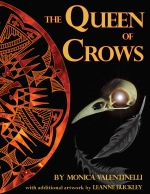
Announcing the Release of THE QUEEN OF CROWS

The Queen of Crows by Monica ValentinelliCentered around a short story entitled “The Queen Of Crows,” I designed a unique, digital product that I think you’ll really enjoy. At a retail price of $4.99, you will receive a magazine-style layout of THE QUEEN OF CROWS, a professional illustration of a character named Mahochepi and more!

This product is the first digital release set in the world of the Violet War and is also the first fiction product published through Flames Rising Press. The short story, which is entitled “The Queen of Crows,” takes place during the 1860s and focuses on the tough decisions that a Navajo elder named “Tse” must make to save his people. Will he summon Mahochepi, the Queen of Crows, without knowing who–or what–she is? Read the story and find out!

Here’s what you can expect to receive when you purchase THE QUEEN OF CROWS:

    * The Queen of Crows: A Short Story
    * Inspiration
    * Original Character Portrait: Mahochepi
    * Who Is Mahochepi?
    * What Is the Violet War?
    * Letter to the Reader
    * The Queen of Crows: First Draft
    * Printer-friendly black-and-white version and full color version

The product will be initially released in digital format through http://www.drivethruhorror.com, but other formats will be made available. To keep up-to-date with news about his product set in the Violet War, be sure to visit VioletWar.com.

What are you waiting for? Visit THE QUEEN OF CROWS at DriveThruHorror.com today! There, you can preview this unique product before you buy and then download it for yourself!

About the Contributors

    MONICA VALENTINELLI is a professional author and game designer. Described as a “force of nature” by her peers, Monica is best known for her work in the horror, dark fantasy and dark science fiction genres and has been published through Abstract Nova Press, Eden Studios, White Wolf Publishing, Apex Magazine and others. Her credits include: a short story titled “Pie” in the award-winning Buried Tales of Pinebox, Texas anthology through 12 to Midnight, an original flash fiction piece entitled “Prey,” which placed an honorable mention in a Mirrormask writing competition and “Twin Designs,” a science fiction novella for the Tales of the Seven Dogs Society collection through Abstract Nova Press.

    LEANNE BUCKLEY is a professional illustrator with over ten years of experience under her belt and has worked for both the comics and gaming industries. Her clients have included: Image Comics, Mattel, White Wolf, Paizo, Wizards of the Coast and several others. In addition to her freelance illustrations, she was a Senior Artist for four years at Humanhead Studios, a video game design studio. Her work includes: Put the Book Back on the Shelf: A Belle and Sebastian Anthology through Image Comics, Cthulhutech through Catalyst Game Labs, the Exalted line for White Wolf Publishing, and layout as well as concept work for Mattel. For more information about Leanne and her contact information, visit http://leannebuckley.com/.

    SHARI HILL is a professional editor, layout artist and writer with over 15 years of experience in non-fiction, gaming, and academic publishing and communications. She is currently a communications coordinator at a private university. As a freelance editor, she contributed to the All Flesh Must Be Eaten line by Eden Studios, and her credits include the Worlds of the Dead setting collection, the Book of Archetypes series and the Eden Studios Presents series. The Queen of Crows features her first credit as a cover artist.

    On Writing a Historically-Accurate Paranormal Short Story

    Currently, I’m working on revisions for a short story entitled THE QUEEN OF CROWS that will be released as part of a digital product through Flames Rising Press. Set in the late 1800s, the plot revolves around a Navajo medicine man who is trying to summon a vengeance goddess called Mahochepi, the Queen of Crows.

    This story has evolved several times from its original incarnation, but the process of editing it has taken longer than some of my other stories. Why? Well, part of the reason is because this story was inspired by a historical event called the “Long Walk.” At the time, the U.S. government had planned to develop a center for Native Americans at a place called “Bosque Redondo.” The center would function as a kind of “rehabilitation” center, where Native Americans would be (for lack of a better word) Americanized. Needless to say, there’s a lot of pieces to the story that required research. For example, did you know that the Navajo refer to themselves as the Diné? Or that they lived in houses called hogans?

    Although this story is a work of fiction, I wanted to give the work an authentic feel without giving my readers a history lesson. Therein lies the need for multiple revisions. You see, regardless of what my intent for the story is, my readers still have to enjoy what I’ve written. Writing anything based on a historical time period is tricky business for any writer. In my case, I found it hard to swallow my editor’s comments that there were sections that came across as being too preachy. What I wound up realizing, was that I was trying too hard to offer readers a chance to empathize with the main character. To me, the idea of being removed from my house to be re-trained to live in a different society is pretty terrifying. While that concept is part of my story, it’s really only one aspect of it. After all, this story is about what happens in my fictional world, not what happened in a factual timeline.

    Because this story will fit together neatly within my Violet War setting, there are a number of paranormal elements to it. Those elements give me a wider berth in terms of what should be (or what shouldn’t be) historically-accurate. Once you introduce magic into any setting, the standard rules may no longer apply. I’m finding that the history portion needed to be there, because it serves as a great foundation. Now, I can go in and “adjust the volume” to better integrate the paranormal elements.

    While I didn’t expect to go through another round of revisions, this process reminded me that it’s easy to have a distorted view of your story when you’re really close to it. By the end of the day, however, this will be a much better story once its done. To me, it will never be “good enough,” but like all writers, I’m definitely my own worst critic.

    Book Trailer for Argentum, My Online Serial Novel

    This is the first time I’ve delved into producing video. I’d appreciate you providing me with feedback if you have the time to check out this short book trailer for Argentum, Book One of the Violet War series I’m writing.

    Genre Fiction and Why I Can’t Look at a Piece of Pie

    As a writer, I’ve found that I really enjoy experimenting with different themes in fiction. My personal preference is to write in the horror, dark fantasy and science fiction genres because of the freedom and flexibility they provide. The settings I create (or write for) offer me the chance to explore heroic and villainous characters in new and interesting ways. You won’t find me writing a lot of gore or stories about “abuse.” I’m more interested in that little bit of light that resides in all of us — even the characters you least expect to see it in.

    As an online marketer, I feel that sociology is part and parcel to what I do every day. From how people are (or aren’t) using specific tools to integrating online networks into your personal life, there’s no doubt that the internet has a profound and significant impact on our lives. I find that my own writing is influenced by popular trends and culture, which is why I tend to explore three-dimensional characters in my fiction rather than plots. Yes, plot is extremely important to my stories, but I prefer to write about the villain that will move mountains for the cute kittens or the hero who doesn’t like eating his peas.

    My latest story will be published in just a few months for an anthology called Buried Tales of Pinebox. Dubbed “Pie,” this is a horror short story about a Skinwalker (i.e. an evil creature who skins people to assume their identity for a limited time) who is trying to help the FBI find a murderer in town to save her own skin. Literally. In this horror story, I had specific themes that I wanted to play around with. First and foremost, the main character is a villain, she’s just not “the” villain in this particular plot. Secondly, since Pinebox is a small town in Texas, I wanted to write a story where I ignored the “small town” tropes and focused on using the mundane to add in a horrific element. Even though I only reference it once or twice in the story as part of the subplot, I grossed myself out to the point where I can’t even look at a piece of pie.

    What’s next for my writing? I just wrote an article for the Flames Rising horror fanzine about the origin of horror tropes, which is a prelude to writing a monthly column featuring a different strong female character in horror. I’m researching a fight scene for my free urban fantasy novel, but I’ve also got a lot of other things in the pipe including five big events between now and Labor Day. As soon as I get an idea of what panels I’m speaking on, I’ll update you with a schedule.

    On Writing a Serial Novel

    Violet WarLast Spring, I had announced that I was working on a free urban fantasy website called Violet War. The goal of the website was to promote a series of books I’ve been working on and offer the first draft of the series’ first book (Argentum) for free.

    Since starting this project, I’ve found that writing a serial novel comes with its own set of challenges related to the fact that this is a novel of discovery.

    In this book, the main character (Sophie Miller) is an exile (think convict) from her magical world. Sophie committed a terrible crime and was later experimented on by the Alchemists then imprisoned by them in a House of Illusion. Those experiments ripped apart her memories, so much so that when the illusion “breaks” she is forced her to deal with the world around her in unusual ways. At first, she doesn’t trust herself but later questions everything she sees.

    These questions have turned into information dumps at times, so much so that some chapters rely on discussion rather than action to drive the plot. Fortunately, I’ve been able to catch those moments by sketching out the entire novel from beginning to end. Pacing is really important to me, because as a reader I get very bored when the story doesn’t move, so my chapters are relatively short. They range from one thousand to twenty-five hundred words for that reason.

    Another way I’m circumventing those information dumps is by adding chapter breaks which are memories and pieces of info that Sophie knows. Once the “House of Illusion” is broken, she begins to remember bits and pieces of her former life. The things she remembers may seem innocuous at first, but might have a larger impact on the overall story in the end. (*hint*)

    Technology has also played a big part in my presentation of this novel. If you look at the physical structure of how Argentum is laid out, you’ll see that there are section breaks in the book. This structure is intentional because of the way this template handles numeric chapters. If I didn’t have a section, then Chapter 10 would have shown up after Chapter 1, which would have made things really confusing for my readers.

    I’m pretty excited to have made so much progress on my project this past weekend. This is definitely new territory for me as an author, and I hope you get the chance to read my work.

    Previous Posts Next Posts


    Monica Valentinelli > Books & Stories

    Looking for Monica’s books and games that are still in print? Visit Monica Valentinelli on Amazon’s Author Central or a bookstore near you.

    Archives

    Back to Top