
The Other Half of Perception is Managing Expectations

After my post earlier this week about managing perceptions as a freelancer, I saw a comment from Keith Anderson about how essential it was to manage expectations.

I absolutely agree.

For me, this is a no-brainer that can be summed up in two words: good communication. When that communication breaks down? That’s when things go wrong. I’ve seen this time and time and time again in many businesses, both as an outsider or when I’m involved on a project. Miscommunication happens in cases when one hand is doing one thing and the other is possessed by another mindset. Management says one thing to one employee and something else to another. A lack of consistency is the other thing that can get very confusing, too, especially when you’re dealing with someone who has little to no experience managing professionals.

My technique is based on asking questions and setting goals. It is extremely rare for me to not fulfill the expectations that are required of me. I am always asking: Is this what you want? Sometimes, the company does not know the answer to that question. By exploring that answer up front you’d be shocked how much money, time and energy is saved.

Having said that, however, there are times when going that extra mile isn’t warranted. That’s where the contract, a style guide and submission guidelines all come into play. The project doesn’t require exploration, it demands production. How many bouts of revisions are required? What format does the work need to be submitted in? Expectations can be very technical, but they are also thematic, too. Research is an invisible cost. An artist needs reference material. A writer needs to find good sources for attribution, reference material on a subject, etc. Creativity is another “cost,” in the sense that bursts of inspiration don’t just happen on a nine-to-five job. They happen at any time, in any place, for any reason. Again, this goes back to why creatives don’t budget based off of hours.

This entire conversation circles back to something I’ve found to be extraordinarily true. There is a huge difference between being proactive and reactive, between providing a service or selling an asset, between building business relationships or focusing on the one-offs. There are so many different ways to manage a business it’s not even funny. The trick I’ve found is this: as an employee or a freelancer, you have to figure out what your core business principles are. Once you have that foundation in place, you can manage expectations with ease. Why? Because then you’re looking at those expectations as a two-way street. It’s not what you can do for someone else. It’s what you can do for each other.
Managing Perceptions as a Freelancer

The other day I took a pulse and asked if (in general) the following were true:

A very challenging thing to manage as a freelancer is other people’s perceptions. You’re either working too hard or not enough. Occasionally, you feel like extra demands are made of your time because you work from home or you’re always online.

The Godfreelancefather Matt Forbeck was quick to point out that sometimes those perceptions are true. E Foley mentioned that she wasn’t aware of many freelancers who struck a positive work/life balance, especially when paying for benefits. L.A. Gilman and Stephen Blackmoore both had some excellent points about how freelancing is more popular in a crappy economy and how high rates translate to not working hard enough. The conversation went on from there when Phil Brucato and Elissa Rich pointed out that ‎”But you do it because you LOVE it. That’s not WORK! You’d do it anyway, so why should you expect to get paid for it? Lots of people do it for free on the internet!”

Sometimes, I find managing perceptions is very difficult; even though I do my best I feel like I can never win. You post about what you’re working on (paid or not) and some people think you’re too busy to take on other projects. You don’t post about what you’re writing or playing and sometimes people think you’re not doing anything. Or, you have a bunch of releases all at once (even though you wrote them over the course of two years) and you need to slow down.

I have a white board (ominously taped to an Independence Day poster) with four buckets: paid, non-paid, spec and promo/PR. I also have a wishlist of projects/companies I’d kill to work for. Every week I have a list to help myself prioritize what I need to be doing. Then? I do it. Sometimes, assignments/meetings take me more time than expected. Other days they go down really quick and easy. Either way, I know what has to be done regardless of my mood, blood sugar levels, and obligations.

The thing is: my schedule isn’t based on hours, it’s based on what I need to earn so I fulfill my obligations professionally, financially and personally. (Which is why I’ve been freelancing as a consultant/marketer for a set number of hours per week to give me the flexibility to write.) I take a lot of pride in my reputation. Every freelancer has one. If I screw up on an assignment? It’s my responsibility to fix it. If there’s a scheduling change on that company’s end? Gotta plow right on through. When the assignment goes down easy, I reset my schedule. I’ve made mistakes in the past because I believed that promo/PR comes first. Boy, was I wrong.

One of the worst demands I’ve ever seen originates from the idea that “Hey, I know an artist/writer/etc. I can just ask them to…” Sure, one or two requests may not seem that big of a deal. Trail John Kovalic around for a while. The sheer volume of requests for free art/time from him is overwhelming and was what spurred this train of thought. I don’t make demands on his time for two reasons. One? I respect him as a professional. Two? I’ve seen how those requests greatly reduce his ability to fulfill his obligations for paid work and new publications. (Which is why last week’s Dork Tower on Speak Out was a total shock on my end.)

It’s hard to say “No” or explain the reality of a situation without sounding like an asshole. Even if it’s prefaced by an apology, it sounds like that person is overwhelmed because they can’t just do that one, little thing or they don’t appreciate their readers/listeners/fans. That’s why I’m working with E Sophia to get an Army of Dorkness fan club going. For John? He has enough fans where that makes sense.

Add to that personal lives/feelings, etc. to the whole perceptions business and you have a recipe for complexity. The other reason why perceptions are tricky, in my mind, is because the industry as a whole is always changing, too. There is no such thing as a stable job anymore. While I don’t feel/want to nitpick and micromanage every comment/blog post/approach I have, I do feel these perceptions are important in a general sense.

If you have tips or stories to share? Please feel free to add your thoughts below.

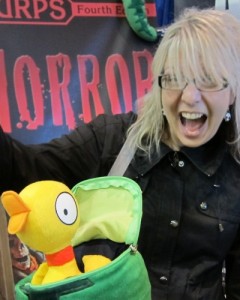
[Photo] The Duck of Doom Emerges

Duck of DoomFor those of you who follow Steve Jackson Games, you may recall a certain Munchkin card called the “Duck of Doom” drawn by John Kovalic. This is a silly version of me pictured with a prototype of the duck emerging from a tentacle dice bag at ACD Games Day. (Yep, you heard me. Tentacle dice bag. And that slippery sucker can hold a lot of dice.)

FlamesRising.com offered a sneak peek of Steve Jackson Games Fall 2011 debuts including the zombie chibithulhu. (Of which I shall be acquiring one. Got the Halloween version at GenCon!) John just nailed down the rest of the art specs for Munchkin Conan. The set’s going to be really cool.

Anyway, thought I’d share a pic of me being silly. ‘Cause sometimes? Silly is good. Oh, I picked up the earrings from Tasty Peach Studios after E Sophia alerted me to the cuteness. It appears I’m collecting skulls now. Hmmm…

😀

Need Feedback on Speak Out with your Geek out

Speak Out with your Geek Out began with a single drop of creativity. Today, from where I sit, I’m floating happily along in an ocean of laughter, smiles and friendship. For that? I thank you muchly. (See: the answer to why is a raven like a writing desk.)

The majority of the responses have been overwhelmingly positive. There have been a few critical conversations that highlighted deeper issues within the community but that is to be expected from an event that got a lot of attention. Speak Out got a signal boost earlier in the week which amplified people’s knowledge about it. Geek Dad on Wired.com blogged about it, John Kovalic from Dork Tower drew a strip about it, Matt Forbeck interviewed me for GeekDad and Jennisodes podcast hosted me for a special chat.

In my mind, what has happened here can and should happen again. Many people would like this to be an annual event. There have been other conversations about going above-and-beyond what this event is. For that? I need your help.

Everything that was done: interviews, comic, writing, hosting, logo, etc. was donated or done on a volunteer basis in an extremely short span of time. Please keep that in mind when you’re answering my questions. You can either comment below or answer these on your blog and link to them in the comments.

(1) Do you feel Speak Out was a positive experience? Why or why not?

(2) Would you like this to be an annual event?

(3) Did you understand participation was voluntary? That there was a reason why “geek” was never defined?

(4) Is there anything that can be done differently for next year?

(5) If your answer to (4) was yes, how would you feel about a Kickstarter to help fund those goals?

Geeking Out about Hobby Anthropology

Today for Speak Out with your Geek Out, I’m going to talk to you about something I enjoy.

When I was growing up, I wanted to be my own brand of heroine. In my head, I morphed Amelia Earhart, Indiana Jones, Leonardo da Vinci, Mozart and Marie Curie all wrapped up into a happy mixture of bravery, intelligence, talent, beauty and adventure. I had no idea where to begin, but it all sounded so incredibly exciting. (Still does.) New worlds, new cultures, new people, new places. I read an entire set of encyclopedias and poured through books in the library. In my head, I pretended to be this amalgamation even though I wasn’t.

Well, here I am and everything is still exciting to me. I love learning and there’s one discipline I often dive right back into without realizing it: cultural anthropology. Reading opened my eyes to the differences between cultures. I took several courses in ethnic literature in college because those stories (some of which chill me to the bone like the autobiographical narrative Our Nig: Sketches from the Life of a Free Black which you can read for free online) helped me see the world through the eyes of different people and fictional characters. Those perspectives stuck and I dove into non-fiction. Ancient Egypt, which I started to read and explore as a child, was the first culture I fell in love with. The names didn’t imprint so well but the discovery of the culture did. My travels stretched into art, music, food and other aspects, too.

I do this sort of thing all the time. I look at trends and big picture stuff. See how cultures evolve and dive into history. It helps me imagine how this big crazy world of hours can hold close to seven billion people and not explode. It allows me to see patterns, sure, but also piece together different lifestyles and unique ways of living. That’s why I call myself a hobby anthropologist, because I’m always amazed at the world and trying to make sense of it by understanding and experiencing cultural evolution and revolution. My philosophy is: everybody has a story to tell. The second part of that is: There’s more than one way to be.

My interest in getting to know our world is part of the reason why I love creating characters and settings for my stories and games. I’m not looking at characters in context of skin or hair color or cosmetic differences. It’s about culture and history, too. It’s about avoiding the “paint” of a skin tone and tying it back into where/how/when that character grew up. Setting details help me shape the story on characters that are more realistic. They’re characterized as opposed to behaving like paper dolls. Vampires, immortals and the undead allow me to dive right back into my hobby and think about what it’d be like to tell a story from a character who watches the world change longer than anyone else alive. That’s part of the reason why I enjoy writing about paranormal characters so much. The world is crazy enough as it is. But throw a 1,000-year old vampire in there?

Thanks for listening to me geek out about hobby anthropology. I love every minute of it.

Previous Posts Next Posts


Looking for Monica’s books and games that are still in print? Visit Monica Valentinelli on Amazon’s Author Central or a bookstore near you.

Archives

Back to Top